ADDITIONAL MENU
About the Journal
| Journal title | J-PE: Jurnal Pendidikan |
| Initials | J-PE |
| Type of Review | Double Blind Review |
| Language | English (preferred) | Indonesia |
| ISSN | E-ISSN: xxxx-xxxx |
| Frequency | June - December |
| DOI | http://dx.doi.org/xx.xxxxxx |
| Editor-in-chief | Dr. Muhammad Dwi Toriyono, M.Pd.I | | |
| Publisher | CV. Gerasi Insan Nusantara |
| Citation Analysis | Google Scholar |
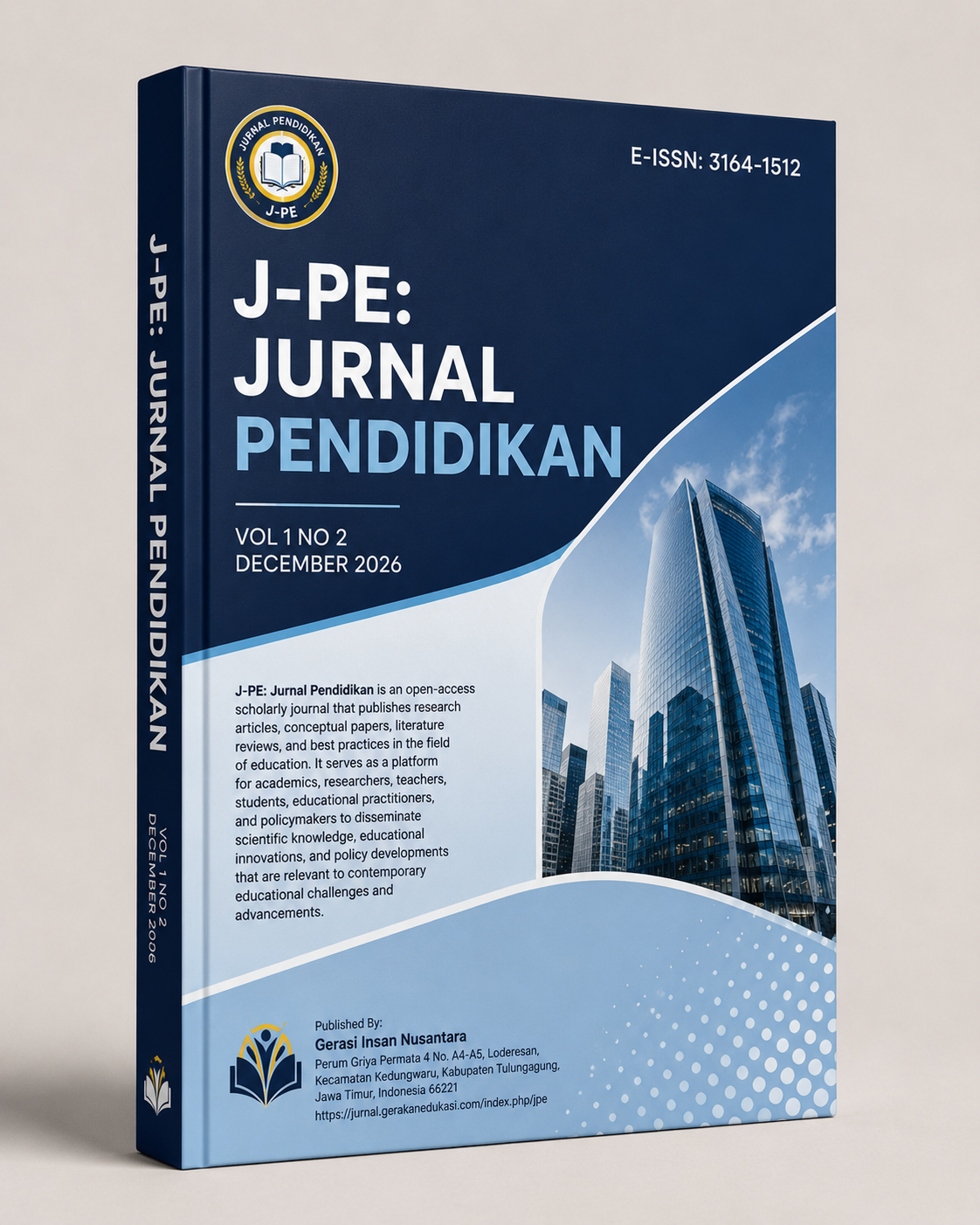
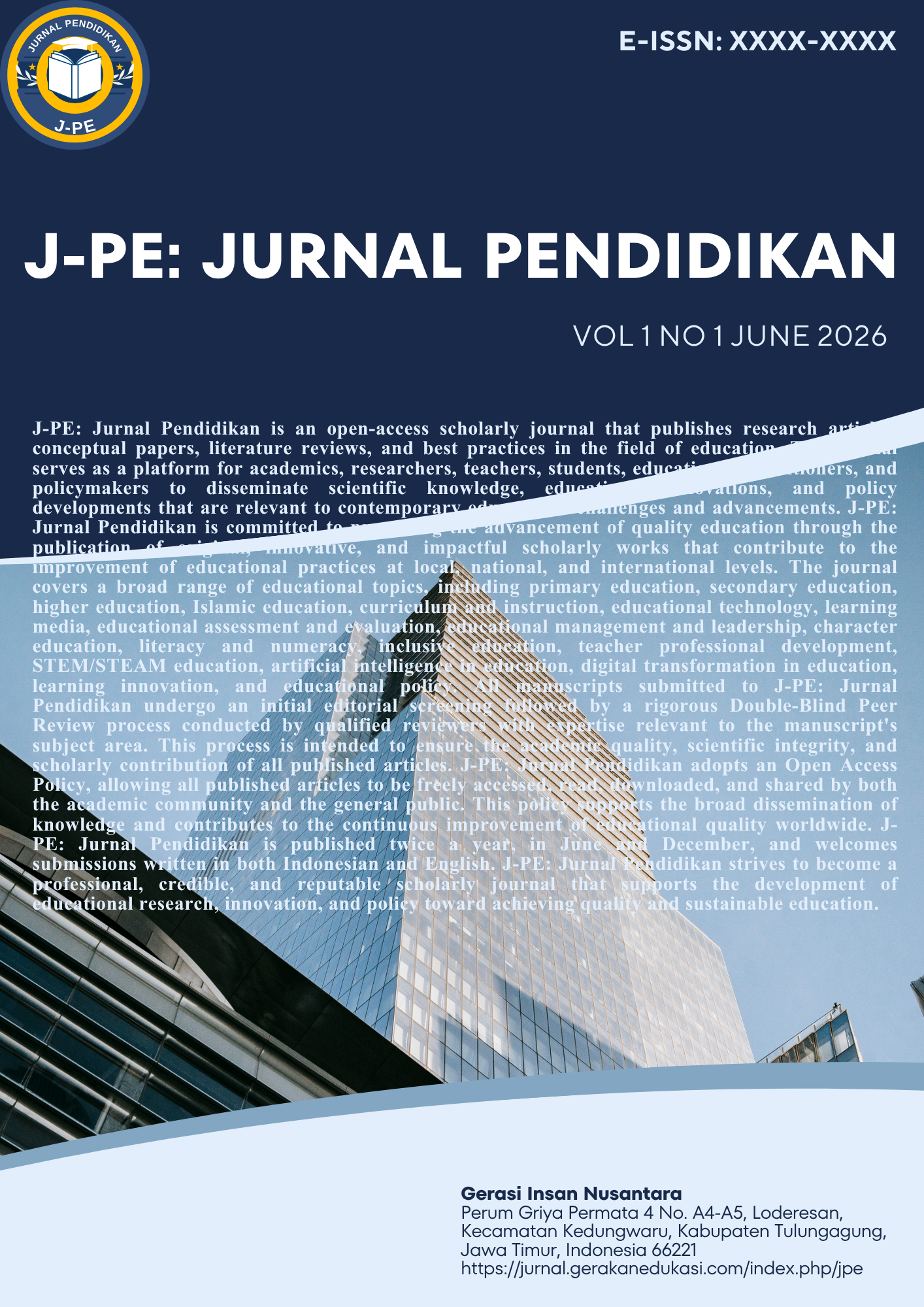
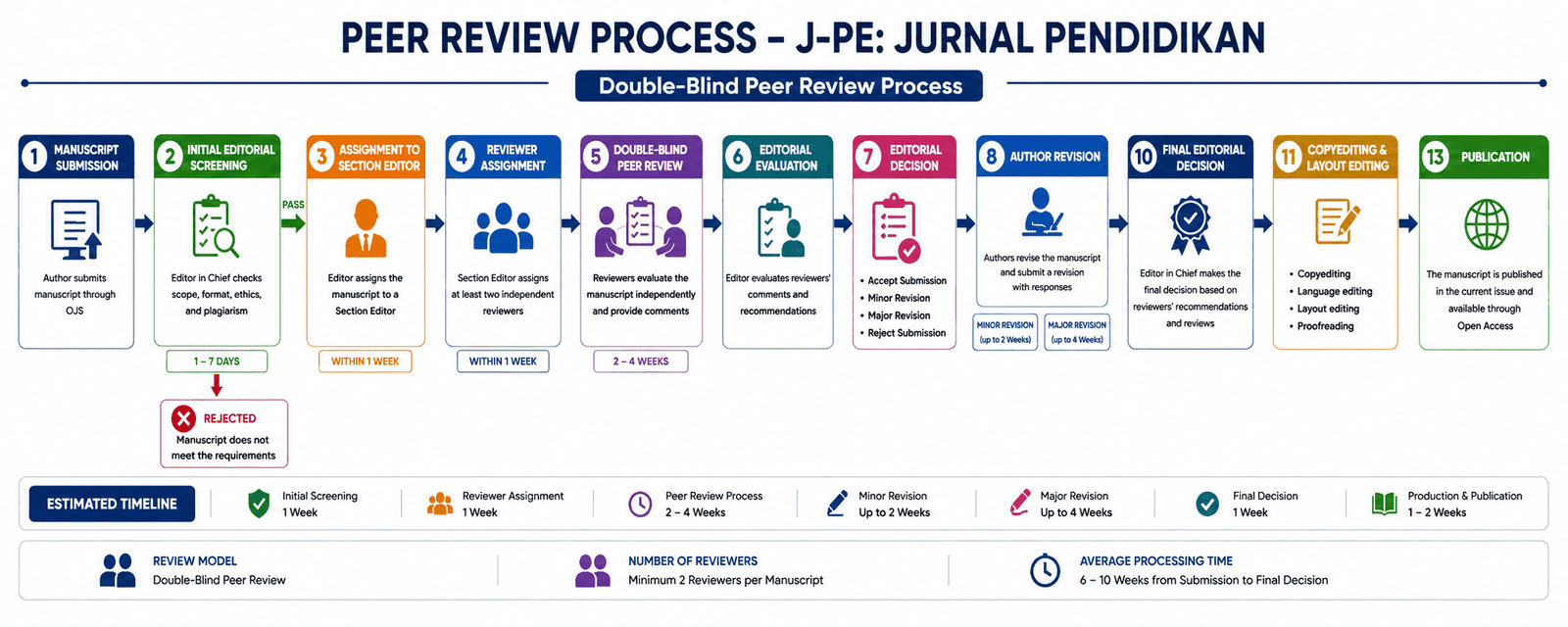
J-PE: Jurnal Pendidikan is an open-access scholarly journal that publishes research articles, conceptual papers, literature reviews, and best practices in the field of education. The journal serves as a platform for academics, researchers, teachers, students, educational practitioners, and policymakers to disseminate scientific knowledge, educational innovations, and policy developments that are relevant to contemporary educational challenges and advancements. J-PE: Jurnal Pendidikan is committed to promoting the advancement of quality education through the publication of original, innovative, and impactful scholarly works that contribute to the improvement of educational practices at local, national, and international levels. The journal covers a broad range of educational topics, including primary education, secondary education, higher education, Islamic education, curriculum and instruction, educational technology, learning media, educational assessment and evaluation, educational management and leadership, character education, literacy and numeracy, inclusive education, teacher professional development, STEM/STEAM education, artificial intelligence in education, digital transformation in education, learning innovation, and educational policy. All manuscripts submitted to J-PE: Jurnal Pendidikan undergo an initial editorial screening followed by a rigorous Double-Blind Peer Review process conducted by qualified reviewers with expertise relevant to the manuscript's subject area. This process is intended to ensure the academic quality, scientific integrity, and scholarly contribution of all published articles. J-PE: Jurnal Pendidikan adopts an Open Access Policy, allowing all published articles to be freely accessed, read, downloaded, and shared by both the academic community and the general public. This policy supports the broad dissemination of knowledge and contributes to the continuous improvement of educational quality worldwide. J-PE: Jurnal Pendidikan is published twice a year, in June and December, and welcomes submissions written in both Indonesian and English. J-PE: Jurnal Pendidikan strives to become a professional, credible, and reputable scholarly journal that supports the development of educational research, innovation, and policy toward achieving quality and sustainable education.
Current Issue
The editorial board of J-PE: Jurnal Pendidikan is pleased to present its inaugural issue, Volume 1, Number 1, June 2026, marking an important milestone in promoting scholarly discourse and research innovation in the field of education. This first edition reflects J-PE’s commitment to advancing educational knowledge through high-quality research, interdisciplinary collaboration, and international academic engagement. The issue brings together contributions from three countries—Indonesia, Malaysia, and Slovenia— representing collaboration among four higher education institutions: STAI Kh. Muhammad Ali Shodiq Tulungagung, Indonesia; Universitas Islam Negeri Sayyid Ali Rahmatullah Tulungagung, Indonesia; University College MAIWP International, Malaysia; and University College Novo Mesto, Novo Mesto, Slovenia. The participation of these institutions demonstrates the journal’s vision of fostering international collaboration and strengthening educational research networks across diverse cultural and academic contexts. This inaugural issue highlights contemporary developments and emerging trends in education, particularly those associated with artificial intelligence, digital transformation, curriculum innovation, and twenty-first-century learning. The published articles explore how educational institutions can respond to rapid technological advancements while maintaining pedagogical effectiveness and educational quality. The studies collectively emphasize the importance of innovation in teaching and learning, the development of future-ready competencies, and the transformation of educational systems to meet the challenges of an increasingly digital world. The issue features five scholarly articles that address critical themes in contemporary education. The first article, “Artificial Intelligence Readiness and Digital Transformation in Islamic Secondary Education,” examines institutional preparedness and strategic factors influencing the adoption of artificial intelligence within Islamic secondary schools. The second article, “Artificial Intelligence Assisted Learning in Primary Education: Examining Its Impact on Critical Literacy, Learning Engagement and 21st Century Skills Development,” investigates the role of AI-supported learning environments in enhancing students’ literacy competencies, engagement, and future-oriented skills. The third article, “Artificial Intelligence Driven Educational Transformation: A Systematic Literature Review of Learning Innovation, Teacher Professional Development and Digital Transformation in K–12 Education (2020–2026),” provides a comprehensive synthesis of recent research regarding AI implementation in educational settings and proposes a conceptual framework for sustainable educational transformation. The fourth article, “Artificial Intelligence In Education For Improving Student Learning Engagement In Higher Education,” explores the contribution of AI technologies to student participation, motivation, and learning experiences in higher education contexts. The final article, “Curriculum Innovation And Instructional Design For Future Oriented Education Systems,” discusses emerging approaches to curriculum development and instructional design aimed at preparing learners for the demands of the twenty-first century. Collectively, the articles presented in this issue contribute valuable insights into how educational systems can leverage technological innovation to improve learning outcomes, strengthen teacher capacity, and support institutional transformation. The studies underscore the growing significance of artificial intelligence as both a technological and pedagogical catalyst for educational improvement, while also highlighting the importance of curriculum innovation, digital competence, and sustainable educational leadership. Through this inaugural publication, J-PE: Jurnal Pendidikan reaffirms its commitment to serving as an international platform for the dissemination of educational research, theoretical advancement, and innovative practices. The journal seeks to encourage scholarly dialogue among researchers, educators, policymakers, and practitioners across disciplines and geographical boundaries. The editorial team warmly invites academics and education professionals to engage with the findings presented in this issue and to contribute to future editions of J-PE: Jurnal Pendidikan, supporting the advancement of educational excellence and innovation in an increasingly interconnected world
Articles
-
Artificial Intelligence Readiness and Digital Transformation in Islamic Secondary Education
- pdf Views: 38 times | Download : 25 times
-
Artificial Intelligence In Education For Improving Student Learning Engagement In Higher Education
- pdf Views: 14 times | Download : 13 times
-
Curriculum Innovation And Instructional Design For Future Oriented Education Systems
- pdf Views: 31 times | Download : 21 times

Manuscript Template
*Please use the template to ensure your manuscript meets the journal's formatting requirements.
Insania is a peer-reviewed scientific journal focusing on applied sport biomechanics and athletic performance.
Read MoreMeet your team of international experts guiding the journal's scientific excellence.
View All Members